
 souvik
RV Park vs Campground: Costs, Hookups, Stay Limits and Which Suits a Camper Van (2026)
By the RVenture Trader team
Short answer: A campground is usually a public site in a park or forest, with more space and nature but fewer hookups. An RV park is usually private, with full hookups, Wi-Fi and laundry, but sites sit closer together. Public campgrounds often cost $20 to $55 a night. Private RV parks average about $54 a night nationally. Camper vans can use both, and most don’t need full hookups, which opens up cheaper sites.
The words get used as if they mean the same thing. They don’t, and the difference shows up in your budget and in what you see out the van door each morning.
A national forest campground and a highway-side RV resort are both technically places to park an RV for the night. One gives you pine trees and a fire ring. The other gives you sewer hookups, a pool and a neighbor eight feet away.
This guide explains the real differences between campgrounds, RV parks and RV resorts, what each costs, and which makes sense for a camper van.
Campgrounds, RV Parks and RV Resorts: The Real Differences
Here’s the simple version.
| Public campground | Private RV park | RV resort | |
|---|---|---|---|
| Who runs it | Federal, state or county agency | Private owner or chain | Private company |
| Setting | Parks, forests, lakes | Towns, highways, tourist areas | Destinations, beaches, sunbelt |
| Site spacing | Usually generous | Often tight | Varies; premium sites larger |
| Hookups | Often none or electric only | Usually full hookups | Full hookups, often 50-amp |
| Amenities | Toilets, maybe showers | Showers, laundry, Wi-Fi | Pools, clubhouse, activities |
| Stay limit | Commonly 14 days | Nightly to monthly | Nightly to seasonal |
| Price | Lowest | Middle | Highest |
For a camper van, the “best” choice depends on how self-contained your van is. A van with solar, tanks and a toilet can enjoy cheap, scenic public campgrounds. A basic van without a bathroom may value a park’s showers more.
How Much Do Campgrounds and RV Parks Cost?
Prices vary a lot by state and season. These ranges give a realistic picture for 2026.
Nightly rates
| Type | Typical nightly cost |
|---|---|
| National forest and BLM campgrounds | $10–$35 |
| State park, dry site | $15–$35 |
| State park, electric or water/electric | $20–$45 |
| State park, full hookup | $35–$55 |
| Private RV park, full hookup | $45–$80 |
| RV resort, premium site | $80–$150+ |
| Dispersed camping on public land | Free |
Average private RV park prices by state
One large dataset from RVSpot covers 11,876 parks across all 50 states. Its national average was $54 a night and $860 a month. A few examples:
| State | Avg nightly | Avg monthly |
|---|---|---|
| Texas | $52 | $575 |
| California | $68 | $961 |
| Florida | $70 | $951 |
| Arizona | $56 | $669 |
| Colorado | $59 | $943 |
| Oregon | $62 | $755 |
Monthly rates are the biggest hidden saving. A park that charges $60 a night might charge $700 to $900 for a full month. That’s roughly half price. If you plan to stay in one area for three weeks or more, always ask for the monthly rate.
Hookups Explained for Van Owners
“Full hookup” sounds essential. For many vans, it isn’t.
| Hookup | What it gives you | Does a van need it? |
|---|---|---|
| Electric (15/20, 30 or 50 amp) | Shore power for AC, heaters, charging | Helpful in heat or for big loads; a 30-amp is plenty |
| Water | Pressurized fresh water at the site | Nice but not needed if you have a tank |
| Sewer | Direct grey/black tank drain | Rarely needed for vans; use the dump station |
| Cable / Wi-Fi | TV and internet | Depends on your work needs |
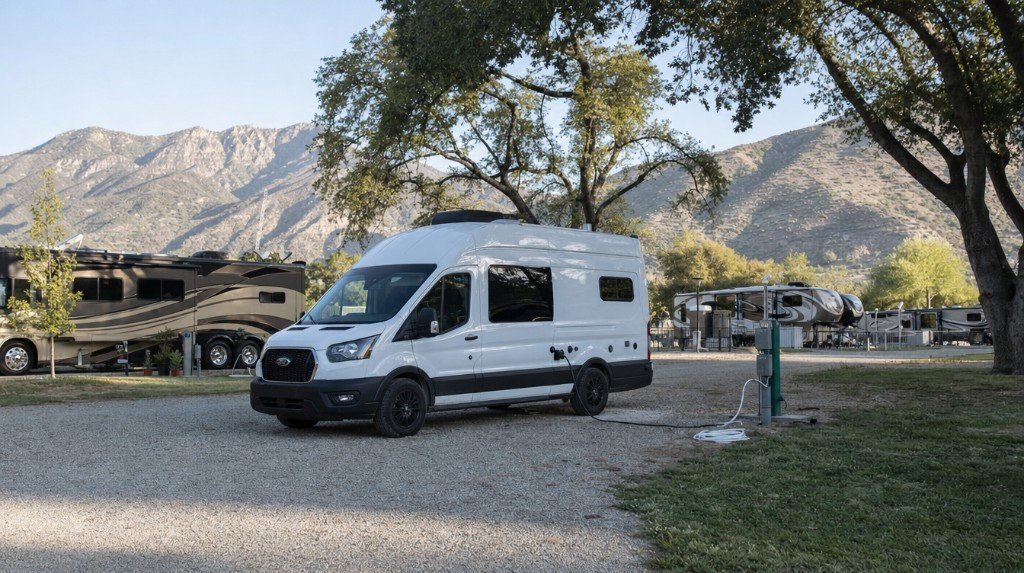
Most camper vans draw far less power than a big motorhome. A 30-amp hookup, or even a standard household-style outlet with an adapter, will charge batteries and run most appliances. Only roof air conditioning really benefits from shore power on hot days. Our camper van air conditioner guide explains the battery math.
Booking an electric-only or dry site instead of full hookups can save $15 to $30 a night. Over a two-week trip, that adds up.
To size your tanks and know how long you can last without water hookups, see our camper van water system guide.
Stay Limits and Long-Term Options
Where you stay depends partly on how long you plan to be there.
- Public campgrounds: Often 14 days in a set period. National parks can be shorter in peak season.
- Dispersed camping: Usually 14 days on BLM land and national forests before you must move a set distance.
- Private RV parks: Nightly, weekly or monthly. Some have long-term residents.
- RV resorts: Often offer seasonal rates for winter visitors in the Sun Belt.
- Membership networks: Groups like Thousand Trails and Harvest Hosts charge a yearly fee for access.
If you’re planning extended time on the road, our van life cost per month guide shows how campground fees fit into a full budget.
Which Option Suits Your Camper Van?
Use this as a quick guide.
| Your van | Best fit | Why |
|---|---|---|
| Solar, lithium, tanks and toilet | Public campgrounds and free camping | You’re self-contained, so you pay for scenery, not services |
| No bathroom | Campgrounds with showers or RV parks | You need facilities |
| Roof AC, traveling in summer heat | RV parks with 30-amp electric | AC needs shore power for long runs |
| Remote worker | RV parks with Wi-Fi, or campgrounds with good cell signal | Connection matters most |
| Family with kids | RV parks or KOAs with play areas | Amenities keep everyone happy |
If you’re still choosing a van, think about this now. A van with a bathroom and good solar costs more up front but can save thousands in campground fees over a few years. Browse vans with an interior shower or our eco-friendly vans with large solar systems.
Pros and Cons at a Glance
Public campgrounds
Pros
– Beautiful settings
– More space between sites
– Low cost
Cons
– Fewer hookups
– Booking competition at popular parks
– Spotty cell signal
Private RV parks
Pros
– Full hookups and Wi-Fi
– Showers and laundry
– Easier last-minute booking
Cons
– Sites close together
– Higher cost
– Often near highways or towns
RV resorts
Pros
– Pools, activities and polished facilities
– Great for longer winter stays
Cons
– Highest prices
– Some limit older or converted vans, so check rules
Check the “RV age rule” before booking resorts. Some resorts restrict RVs older than 10 or 15 years, and a few don’t accept DIY camper van conversions. A quick call avoids a turned-away arrival.
Tips for Saving Money
- Book dry or electric-only sites when you don’t need full hookups
- Ask for weekly and monthly rates
- Travel midweek and in the shoulder seasons
- Mix paid nights with free dispersed camping
- Look at state park annual passes, which can cut entry fees
- Check membership programs if you travel often
For finding free sites, our boondocking guide covers rules, gear and good locations.
Frequently Asked Questions
What is the difference between an RV park and a campground?
Campgrounds are usually public sites in parks or forests with more space and fewer hookups. RV parks are usually private, with full hookups and amenities but smaller sites.
How much does an RV campground cost per night?
Public campgrounds often cost $10 to $55. Private RV parks average around $54 nationally, and RV resorts can exceed $100.
Do camper vans need full hookups?
Usually not. Most vans do fine with electric only, or no hookups at all if they have solar, a water tank and a toilet.
Are RV parks cheaper by the month?
Yes. Monthly rates are often around half the cost of paying nightly for the same period.
Can I stay at an RV park long term?
Many private RV parks offer monthly stays. Public campgrounds usually limit stays to about 14 days.
Do RV resorts accept camper vans?
Most do, but some have age rules or restrictions on DIY conversions. Call ahead to confirm.
Choose a Van That Fits Your Camping Style
Your van decides where you can comfortably stay. Browse our camper vans for sale or the Class B camper vans section, and look closely at tank sizes, solar and bathroom options before you buy. Use our payment calculator to compare.