

 souvik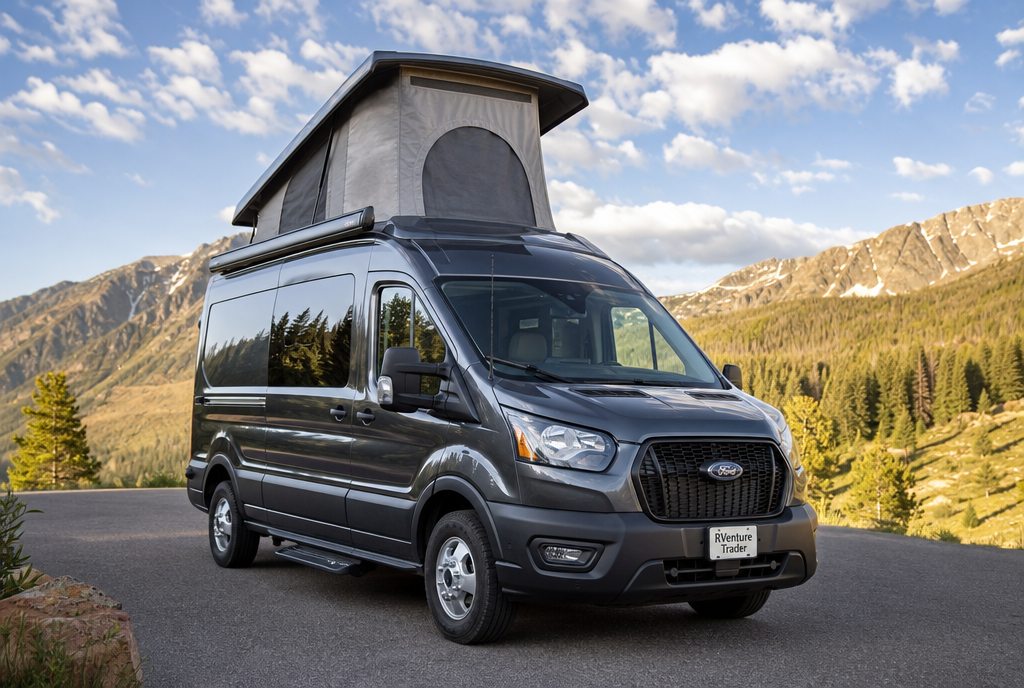
Ford Transit Camper Vans Explained: Roof Heights, AWD and Real Costs
The Ford Transit is the pragmatist’s camper van chassis. It gives up some prestige and some diesel range to the Sprinter, and gets back a nationwide service network, gas-engine simplicity, cheaper parts, and a configuration list so long that almost any camper layout can be accommodated without compromise.
It’s also the chassis with the most confusing shopping experience, because “Ford Transit” covers more than a hundred cargo van permutations plus a separate, discontinued small van that shares the name. Here’s how to navigate it.
Short answer: The full-size Ford Transit is the best camper base in the Ford range — specifically the T-250 or T-350 High Roof on the 148-inch wheelbase. The 2026 Transit cargo van starts around $48,400 for a T-150 Low Roof, the T-250 at about $49,400, and the electric E-Transit at $55,355. Finished Transit campers run roughly $110,000–$220,000 new or $55,000–$110,000 used. The smaller Transit Connect is no longer sold new in the US or Canada — it’s a used-market micro-camper option only.
Understanding the Transit lineup
The Transit has no conventional trim ladder. Instead, the van you get is defined by a combination of three variables, which is why two vans with the same badge can be wildly different vehicles.
Series (payload rating): Transit-150, Transit-250, Transit-350, Transit-350 HD single rear wheel, and Transit-350 HD dual rear wheel, the last of these reaching up to 11,000 lbs GVWR.
Roof height: Low, Medium, or High. The High Roof delivers 81.5 inches of interior height, which accommodates people up to about 6’5″ without ducking.
Wheelbase and length: 130-inch and 148-inch wheelbases, in Regular, Long, and Extended Long body lengths. Extended Long is High Roof only and reaches up to 487.3 cubic feet of cargo volume.
| Configuration | Interior height | Cargo volume | Camper verdict |
|---|---|---|---|
| Low Roof, Regular Length (130″) | ~56.9 in | 246.7 cu ft | Fits a residential garage — only viable with a pop-top |
| Medium Roof, Long Length (148″) | Standing for shorter adults | Mid | Compromise choice; rare on the used market |
| High Roof, Long Length (148″) | 81.5 in | ~404 cu ft | The sweet spot — standing room, parkable, most conversions use this |
| High Roof, Extended Length (148″) | 81.5 in | 487.3 cu ft | Full bath + fixed bed + garage; ~22 ft long |
Maximum payload runs roughly 4,085 lbs on a Low Roof down to 3,536 lbs on a High Roof Extended — and payload, not volume, is usually what limits a heavy four-season build. Filter listings by size using short wheelbase vans or long wheelbase vans.
Engines, AWD and the electric option
The 2026 Transit offers V6 gas engines — a naturally aspirated 3.5-litre and the turbocharged 3.5-litre EcoBoost — paired with a ten-speed automatic. Two details matter for camper buyers.
Intelligent AWD is available without raising the floor or seat height. This is a genuine advantage over some competitors: you get all-weather traction without losing interior height or gaining a step up into the van. If you camp in snow or on forest roads, it’s worth the option cost.
The E-Transit is not a touring camper. With an EPA-estimated 159 miles of range, the electric Transit works as a stealth city camper, a mobile office parked at job sites, or a weekender within a tight radius. It does not work for cross-country travel, and heating a van overnight from the traction battery erodes range further.
Also new for 2026: every Transit cargo van comes standard with the 12-inch SYNC 4 touchscreen, and the vans are pre-wired for upfit integration so aftermarket installations don’t compromise the factory warranty — a real benefit if you’re converting yourself.
Ford Transit vs Mercedes Sprinter for a camper
| Ford Transit | Mercedes Sprinter | |
|---|---|---|
| Bare van from | ~$48,400 | ~$50,830 |
| Fuel | Gas V6 or electric | Turbodiesel |
| Range between fills | Shorter | Longer — diesel efficiency advantage |
| Servicing | Any Ford dealer; cheap parts | Commercial specialists; expensive |
| Interior height (high roof) | 81.5 in | Comparable |
| Resale | Good | Strongest in the segment |
| Best for | Lowest total cost of ownership; DIY builders | Long-range touring; premium resale |
If you’re weighing the two seriously, our Mercedes Sprinter camper van guide covers the other side of this decision in the same depth, and you can compare live inventory across Transit camper vans for sale and Sprinter camper vans for sale.
The Ford Transit Connect camper van: read this before you search
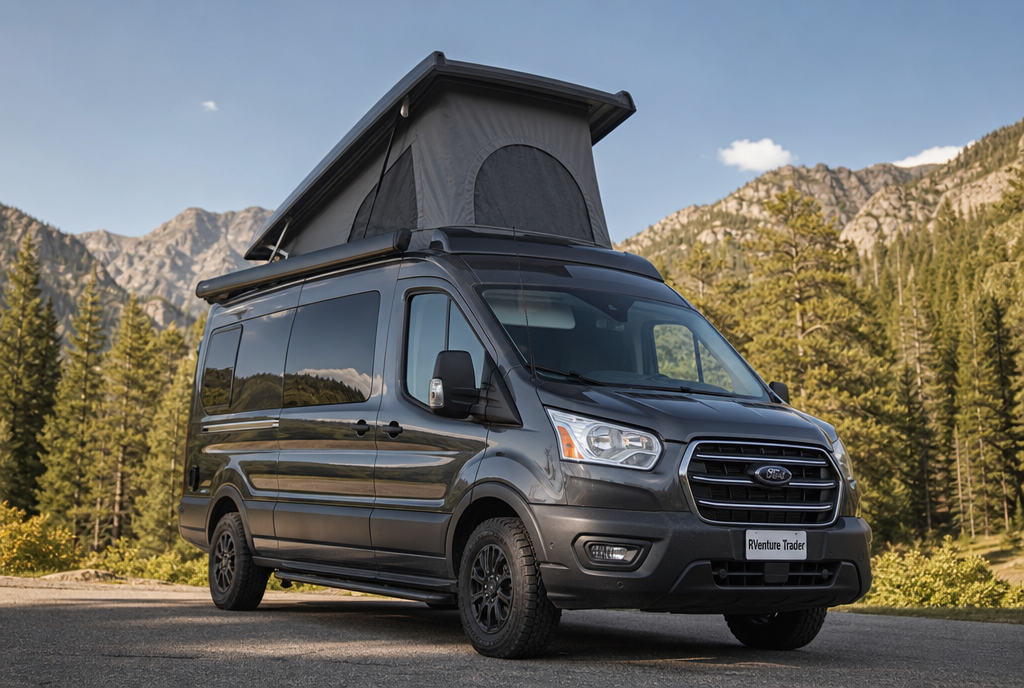
A lot of content online still treats the Transit Connect as a current option. It isn’t, in North America. Ford ended Transit Connect sales in the US and Canada after the 2023 model year, citing reduced global manufacturing complexity and falling demand in the compact van segment. The nameplate continues in Europe as a rebadged Volkswagen Caddy, but you cannot buy a new one from a US dealer.
That doesn’t make it a bad camper. It makes it a used-only proposition, and a genuinely interesting one:
- Price. Used Transit Connects typically land in the $8,000–$20,000 range depending on year and mileage — the cheapest realistic entry into a modern-ish micro-camper.
- Footprint. It parks like a car and fits any garage, which makes it the strongest stealth-camping platform in the Ford range. Our stealth camping guide covers how to use that advantage properly.
- The limit. No standing room, no room for an interior bathroom, and a bed that runs diagonally or requires a rear extension for anyone over about 5’10”. It’s a weekender and a festival van, not a full-timer.
- Parts risk. With no new sales in North America since 2023, plan for a longer wait on some parts, and note that transmission issues are the most commonly reported fault on the model.
If you want small but with standing height, a Low Roof full-size Transit with a pop-top is usually the better answer — see vans with pop tops and our roundup of the best small camper vans.
Buying a Transit work van and converting it
This is the cheapest legitimate route to a capable Transit camper, and it’s why so many buyers search for a Transit work van rather than a camper van. Ex-fleet Transits come to market in volume, are usually well documented because businesses service them on schedule, and depreciate hard.
What to target and what to avoid:
| Factor | Target | Avoid |
|---|---|---|
| Previous use | Highway service fleet, single operator | Urban parcel delivery — hundreds of daily stop-start cycles |
| Mileage | Under 120,000 highway miles with records | Low mileage with no service history |
| Configuration | T-250/T-350 High Roof, 148″ WB | Low Roof unless you’re fitting a pop-top |
| Body condition | Straight panels, sound floor, few roof penetrations | Existing roof holes from removed racks or vents |
| Interior | Bare walls, or shelving you can unbolt cleanly | Glued-in liners hiding rust and damage |
Realistic budget: $18,000–$35,000 for a sound used High Roof, plus $25,000–$60,000 for a professional conversion or $15,000–$35,000 in materials if you build it yourself. Browse current work vans for sale and the wider Ford van inventory to see what’s actually available at your budget.
One warning that catches DIY builders out: a self-converted Transit usually keeps its cargo-van title, which closes off RV financing and complicates insurance. Read how camper van financing actually works before you buy the shell, not after.
What a Ford Transit camper van costs
| Route | Total cost | What you get |
|---|---|---|
| New factory Class B on Transit | $110,000–$220,000 | RV title, warranty, dealer service, fixed floorplan |
| Custom professional conversion | $95,000–$180,000 all-in | Your exact layout; 6–18 month wait |
| Used converted Transit (2–5 yrs) | $55,000–$110,000 | Best value in the segment |
| Used work van + DIY build | $33,000–$70,000 | Cheapest per feature; hardest to finance |
| Used Transit Connect micro-camper | $12,000–$28,000 | Weekender only; no standing room |
Insurance on a converted Transit typically runs $500–$1,500 a year for recreational use — the lower end of the camper van range, because the base vehicle value is lower than a Sprinter’s. Ask for agreed value on the buildout regardless, or a total loss could pay out the van and ignore your interior.
Frequently asked questions
Which Ford Transit is best for a camper conversion?
The T-250 or T-350 High Roof on the 148-inch wheelbase, Long Length body. It gives 81.5 inches of interior height, enough length for a fixed bed plus kitchen and bathroom, and remains parkable. Add Intelligent AWD if you camp in snow or on unpaved roads.
Can you still buy a new Ford Transit Connect camper van?
Not in the US or Canada. Ford ended Transit Connect sales in North America after the 2023 model year, so any Transit Connect camper is built on a used van. The model continues to be sold in Europe.
Is the Ford Transit or the Sprinter cheaper to own?
The Transit, clearly. Gas engines are simpler than the Sprinter’s diesel, parts cost less, and any Ford dealer can service it. The Sprinter recovers some of that gap through better fuel efficiency on long trips and stronger resale value.
How tall is a high roof Ford Transit inside?
81.5 inches of maximum interior height, which suits people up to about 6’5″. A finished conversion loses a little to floor build-up and ceiling insulation, so expect roughly 76–79 inches of usable standing height depending on the builder.
Can an E-Transit work as a camper van?
For local use, yes. At an EPA-estimated 159 miles of range it suits stealth city camping, mobile office use, and short weekend trips near home. It’s not suitable for touring, and running a heater or air conditioner overnight reduces available driving range.
What does a used Ford Transit camper van cost?
A professionally converted Transit two to five years old typically sells for $55,000 to $110,000, depending on layout, electrical capacity and whether it has a bathroom. That’s usually 30–45% below the equivalent new build.
Next steps
Decide roof height and wheelbase first, check payload against the build you want second, and confirm the title classification third. Then compare real vans: Transit camper vans for sale for finished conversions, work vans for a conversion base, or every camper van currently listed if you’re still comparing chassis.