
 souvik
Van Life With Kids: Finding the Right Camper Van for a Family of 4
A family camper van has to solve a problem couples’ vans never face: four legal, forward-facing seatbelts and four real sleeping spots — inside a vehicle that still fits in a parking space and doesn’t require a special license. It’s absolutely doable in 2026, but the layout decisions are far less forgiving than in a two-person van, and buying the wrong rig is an expensive mistake to unwind.
Here’s exactly what to look for, the three layout formulas that actually work, a cost breakdown by build type, and the practical realities of van life with kids. To see what family-ready rigs exist right now, start with the camper vans for a family of 4 collection on our marketplace.
Rule #1: Seats Before Sleeps
The hard constraint in a family van isn’t beds — it’s crash-tested seating. A family of four needs a second-row bench with proper three-point belts and, for young kids, LATCH anchor points for car seats. This is your first filter, applied before you fall in love with any interior photo.
| Seating Requirement | What to Verify | Red Flag |
|---|---|---|
| Second-row bench | Factory seat or certified aftermarket (with documentation) | Homemade plywood bench, lap-only belts |
| Car seat compatibility | LATCH anchors or verified belt paths; ~40″ bench width for two child seats | “Kids can just ride on the sofa” |
| Seat mounting | Bolted through floor to reinforcement plates or seat base | Screwed into wood subfloor only |
| Walk-through access | Can you reach kids from the front without stopping? | Bench blocks the aisle completely |
Sleeping capacity does not equal seating capacity — a van that “sleeps 4” may only legally carry 2 or 3. Any listing worth considering states its belted seating count; on RVenture Trader, seating and sleeping capacity appear in every family van’s specs.
The 3 Family Layouts That Actually Work
Layout 1: Pop Top + Fixed Bed (the space multiplier)
Parents sleep in the main fixed bed downstairs; kids sleep upstairs in the pop-top roof bed. This is the most popular family formula because it adds two berths without adding any length — the van still drives, parks, and garages like a standard rig. Kids also universally love the “treehouse.” Browse vans with pop tops to see this layout across makes and budgets, and read our full pop top camper van guide for the pros, cons, and winter considerations.
Layout 2: Bunks Over the Garage
Long-wheelbase vans can fit two transverse kids’ bunks in the rear, with the parents’ bed above them or a convertible dinette up front. Bunks work year-round — no canvas walls in a January storm — and each kid gets a private nook. The cost is that you need a long wheelbase Sprinter or Transit, which changes how the van drives, parks, and fits in campsites.
Layout 3: Convertible Dinette + Fixed Bed
The dinette becomes the kids’ bed each night. This is the cheapest four-sleeper to buy, and the dinette doubles as homework/meal/game HQ all day. The downsides are real, though: nightly conversion with tired kids gets old fast, and the family loses its lounge whenever anyone naps.
| Layout | Sleeps | Van Length Needed | Winter-Ready | Typical Cost Premium | Best For |
|---|---|---|---|---|---|
| Pop top + fixed bed | 4 | Standard (19–21 ft) | Moderate (canvas walls) | +$12k–$20k for the top | 3-season families, city-friendly travel |
| Rear bunks | 4–5 | Long (22–24 ft) | Excellent | Built into larger van price | Full-time & four-season families |
| Convertible dinette | 4 | Standard or long | Excellent | Lowest | Budget-focused, vacation-only use |
Which Base Van for a Family?
| Ram ProMaster 159″ | Ford Transit 148″ | Mercedes Sprinter 170″ | |
|---|---|---|---|
| Interior width | ~75″ (widest — roomier floor plans) | ~70″ | ~70″ |
| Roof height options | High roof standard | Multiple, incl. extended high | Multiple |
| Drivetrain | FWD only | RWD or AWD | RWD, AWD/4×4 |
| Fuel | Gas | Gas/EcoBoost | Diesel |
| Service network | Any Ram dealer | Any Ford dealer | Sparser, pricier |
| Value per square foot | Best | Middle | Priciest |
| Resale | Good | Strong | Strongest |
- Ram ProMaster 159″ — widest body in the class, meaning beds fit sideways and floor plans feel genuinely roomier with four people inside. Best value per square foot. See ProMaster builds.
- Ford Transit 148″ — tall roof options, a gas engine any mechanic can service, AWD available for snow states. See Ford builds.
- Mercedes Sprinter 170″ — the most room, the best resale, the highest price. See Sprinter builds.
Our Sprinter vs Transit vs ProMaster guide compares the platforms in depth. And if you’re wondering whether a family camper van technically counts as an RV — it usually does, and the classification matters for insurance, financing, and campground rules. Here’s what a Class B RV actually is, and you can browse dedicated Class B camper vans on the marketplace.
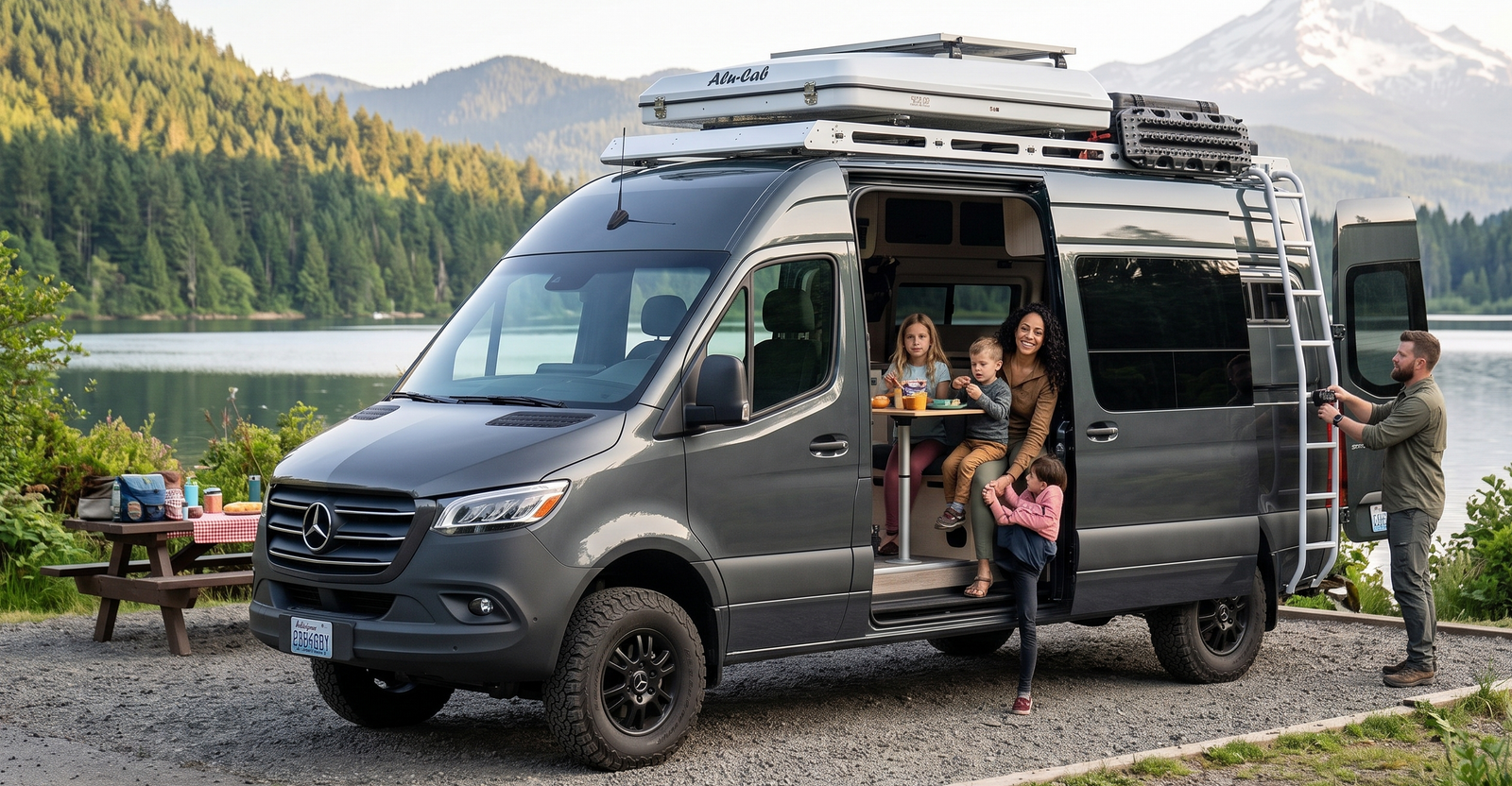
Bathroom or No Bathroom?
With kids, an interior toilet moves from “nice to have” toward “sanity saver” — midnight bathroom runs from a dark campsite and highway emergencies are a completely different equation with a 5-year-old. If it’s on your list, look at vans with an interior shower and read our guide to bathroom layouts that work to see how builders fit a wet bath without sacrificing a berth. Families who skip the full bathroom usually run a cassette/portable toilet plus campground showers — our camper van shower options guide covers those setups.
What Does a Family Camper Van Cost in 2026?
Family-capable builds carry a premium because certified seating, pop tops, and four-sleeper layouts all add cost:
| Build Type | Price Range | Notes |
|---|---|---|
| Used family conversion (4–7 yrs) | $70,000–$120,000 | Verify seat certification & pop-top condition carefully |
| New ProMaster/Transit family build | $110,000–$160,000 | Best value for new; gas running costs |
| New Sprinter with pop top or bunks | $150,000–$200,000+ | Four-season, AWD options, strongest resale |
| Factory pop top alone (added to any build) | $12,000–$20,000 | Also adds resale value |
| Certified second-row bench (aftermarket) | $3,000–$8,000 installed | Never cheap out here |
For the complete cost picture — chassis prices, system costs, depreciation curves, monthly payment tables — see How Much Does a Camper Van Cost in 2026?. Many families finance over 15–20 years on RV loan terms, which keeps a $130k rig near $1,200/month; run your numbers in the loan calculator and read the financing guide for loan options. Buying used? Our used camper van inspection checklist is written for exactly this purchase.
Family Van Life: Practical Realities
- Storage discipline: four people’s gear in ~80 square feet means packing cubes, under-bunk bins, and almost always a rooftop box or rear rack.
- Power needs: add roughly 30% battery capacity versus a couples build — more devices, more fridge openings, more fan-hours, more everything.
- Trip length matters: a layout that’s perfect for two-week summer trips (dinette conversion) can be miserable for full-time travel, and vice versa. Buy for the trips you’ll actually take in year one.
- School-age flexibility: many families start with summer-only travel before committing to full-time road schooling — the right van works for both phases.
- Where you’ll camp: families gravitate to campgrounds for facilities, but free dispersed camping stretches budgets enormously — see Boondocking 101 for how families camp free safely.
Frequently Asked Questions
Can a family of 4 live in a camper van?
Yes. The proven formula is four belted seats plus either a pop-top roof bed or rear bunks for the kids. Full-time families typically choose long-wheelbase vans with bunks; vacation-focused families do great with pop tops on standard-length vans.
What is the best camper van for a family of 4?
For most families: a ProMaster 159″ or Transit 148″ with a certified second-row bench and a pop top. If budget allows and you travel year-round, a Sprinter 170″ with fixed rear bunks is the most comfortable long-term setup.
How many people can legally ride in a camper van?
As many as there are properly rated, three-point belted seats — sleeping capacity does not equal seating capacity. Always verify the belted seat count and mounting certification before buying.
Do kids need car seats in a camper van?
Yes — the same state car seat laws apply in camper vans as in any passenger vehicle. Confirm the bench has LATCH anchors or belt paths compatible with your specific seats before purchase.
How big of a camper van does a family of 4 need?
A standard-length van (19–21 ft) with a pop top works well for most families; full-timers usually prefer 22–24 ft long-wheelbase vans with fixed bunks for year-round comfort.
Ready to find your family’s rig? Browse family-ready camper vans with verified seating and sleeping specs — or explore all listings and filter by what matters to your crew.
Boondockingcamper van comparisoncamper van costcamper van financingcamper van inspection checklistcamper van layoutscamper van showerClass B RVDispersed Campingfamily camper vanfixed bed camper vanFord TransitMercedes Sprinterpop top vanRam ProMasterRV loansused camper vanvan conversionvan lifevan life with kids