
 souvik
Mercedes Sprinter Camper Van Guide: Layouts, Prices and Sprinter Camper Van for Sale
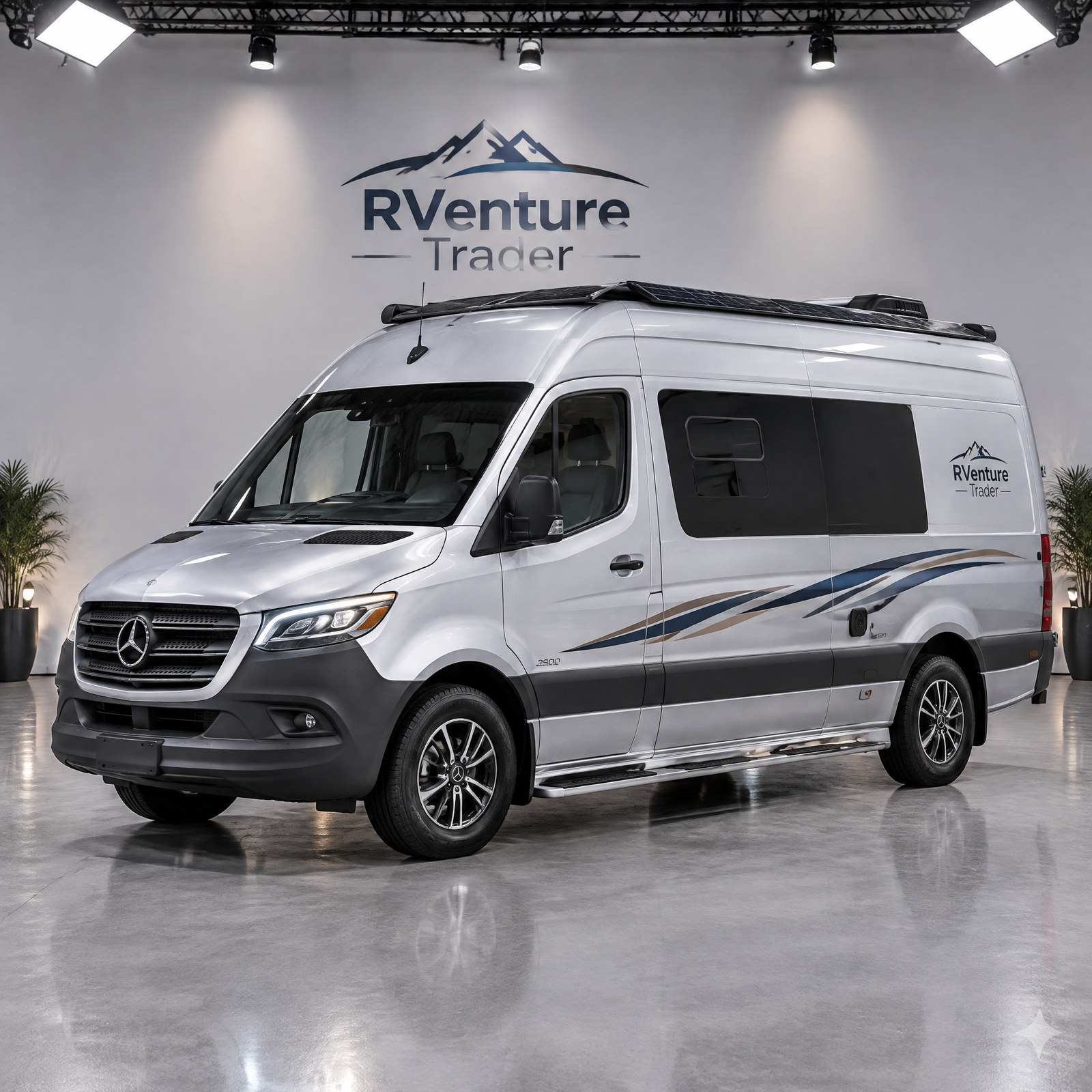
The Mercedes Sprinter camper van is the default platform for serious van life in the US, and it earned that position for three specific reasons: standing headroom, factory AWD, and diesel range that turns a fuel stop into a non-event.
It is also the platform where buyers spend the most money on the wrong specification. A 170″ extended AWD build is a magnificent vehicle and completely wrong for someone who camps six weekends a year near home. This guide covers what to specify, what it costs to buy and run, and what to demand from any mercedes sprinter camper van for sale before you wire a deposit.
Short answer: A Mercedes Sprinter camper van is a Sprinter cargo van converted for living — bed, galley, water, lithium power and usually a toilet or wet bath. New professional builds run $130,000–$220,000 in 2026; used examples 3–6 years old typically sell for $90,000–$150,000.
Choosing the chassis: 144″ vs 170″
| 144″ wheelbase | 170″ wheelbase | 170″ extended | |
|---|---|---|---|
| Overall length | ~19.5 ft | ~22.5 ft | ~24 ft |
| Sleeps | 2 | 2–4 | 4–5 |
| Fits a parking space | Yes | Overhangs | No |
| Room for a fixed shower | Tight | Yes | Yes, plus garage |
| Crosswise bed | Only if under ~5’10” | Yes | Yes |
| Typical build price | $130,000–$170,000 | $150,000–$200,000 | $170,000–$230,000 |
The 144″ is the better daily driver; the 170″ is the better home. Choose by how many nights a year you will actually sleep in it.
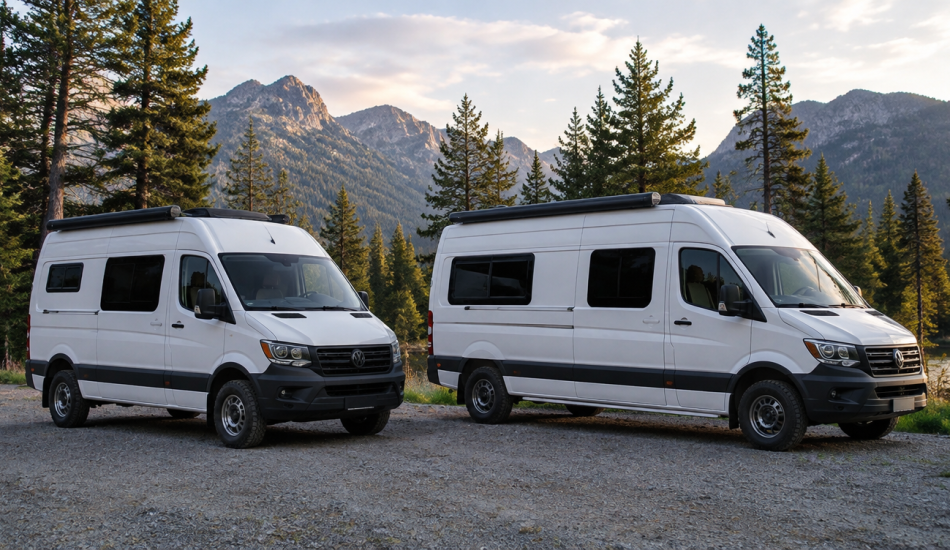
A practical rule: under 40 nights a year, the 144″ almost always makes people happier because it is usable the other 325 days. Above 100 nights, the 170″ earns its length within the first month. Compare both in our short wheelbase van and long wheelbase van collections.
AWD or 4×4: do you need it?
- Cost: adds roughly $6,000–$10,000 to the base van and $10,000–$20,000 to a finished build’s asking price.
- Fuel penalty: typically 1–2 MPG.
- Ride height: AWD versions sit higher, which also improves departure angle and helps on washboard forest roads.
- Worth it if you camp on forest service roads, travel in snow states, or regularly park on soft ground.
- Skip it if you mostly stay on pavement and at established campgrounds — a good set of all-terrain tyres solves roughly 80% of the traction problem for a fraction of the price.
Current drivetrain options are published at Mercedes-Benz Vans USA. For a full drivetrain comparison against the Transit, see our dedicated AWD van guide.
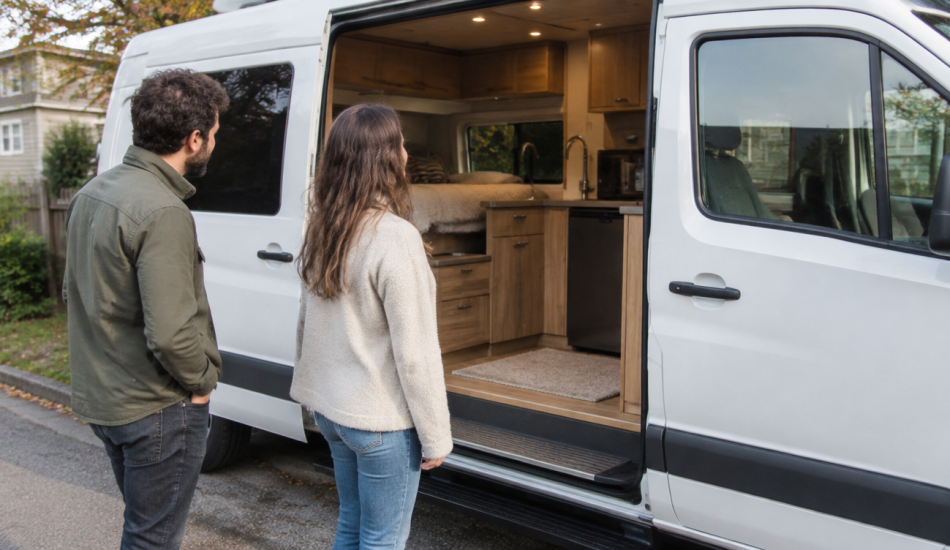
What a Mercedes Sprinter van camper should include
Electrical system
This is where the money goes and where quality varies most. A capable modern build has 400–1,000 Ah of lithium (roughly 5–12 kWh), a 2,000–3,000W inverter, 300–800W of solar, and DC-DC charging from the alternator so the van recharges while you drive. Ask for the wiring diagram, the fuse ratings and the battery’s install date and cycle count. A bank that is “a few years old” is a $4,000–$9,000 unknown.
Heating
A diesel air heater drawing from the main fuel tank is the standard for four-season use — no propane refills, no separate tank, and it runs for pennies an hour. Propane furnaces are cheaper to install and more expensive to live with.
Water
Twenty to forty gallons fresh, with tanks located inside the insulated envelope if you plan to travel below freezing. Ask where the tanks and lines actually sit; “winterised” means nothing without that detail.
Bathroom
A wet bath in the 170″, or a cassette toilet in tighter 144″ layouts. If an indoor shower is a hard requirement, filter straight to vans with interior shower.
Insulation and ventilation
Closed-cell foam or wool, with thermal bridging addressed at the metal ribs — this is exactly where cheap builds cut corners invisibly, and you cannot inspect it after the walls close. A roof fan plus at least one opening window is non-negotiable, because condensation rather than cold is what ruins winter trips and eventually rots a build from the inside.
Sprinter camper van prices in 2026
- $90,000–$130,000 — used builds, 3–7 years old, 2WD, lead-acid or early lithium systems. Budget for a battery replacement in the near term.
- $130,000–$170,000 — new professional 144″ builds with lithium power, diesel heat and a wet bath.
- $170,000–$220,000 — new AWD 170″ builds, 10 kWh+ power, four-season specification, interior shower, rear garage.
- $220,000+ — bespoke off-grid, expedition and luxury camper van interiors.
See what is available right now in Sprinter camper vans for sale, or browse every Mercedes-Benz van listing. Model your monthly payment on the payment calculator before shortlisting.
Running costs people underestimate
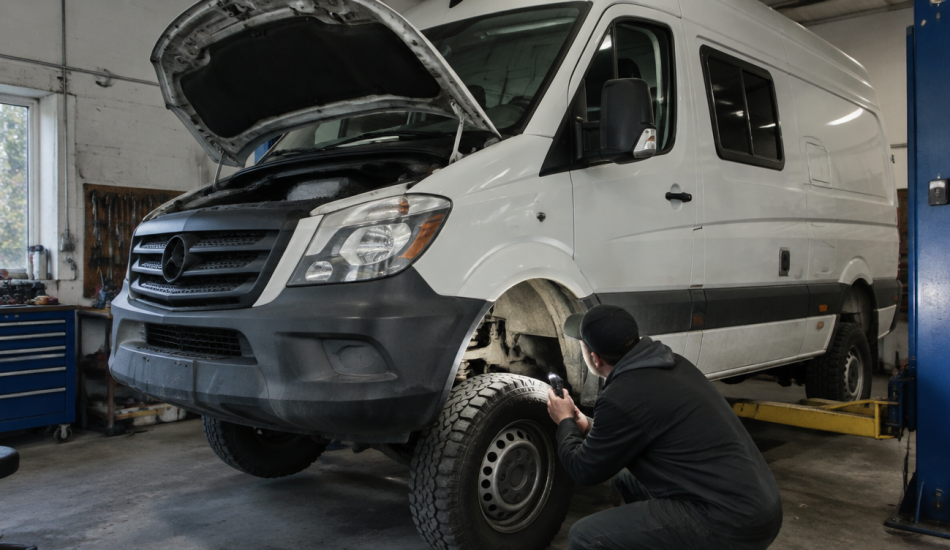
- Service: Sprinter A and B services typically run $400–$900 at a dealer. Independent Sprinter specialists cost meaningfully less and are worth finding before you buy, not after.
- Emissions system: diesel Sprinters need regular highway miles to complete DPF regeneration. A van used only for short trips will eventually throw expensive faults — this is the single most common ownership complaint.
- Tyres: commercial LT tyres, $250–$400 each, replaced on age as well as tread. A full set is a $1,200–$1,600 event.
- Insurance: a converted Sprinter needs a policy covering the conversion value, not just the chassis. Get this quoted in writing before you buy, because some carriers decline undocumented builds outright.
- Fuel: expect 15–20 MPG on 2WD diesel, 13–18 MPG on AWD. Verify by model year at fueleconomy.gov.
- Parts lead times: can run weeks on some components, versus days for a Transit. Factor this into how you use the van.
Buying checklist for a Sprinter camper van for sale
- Service history from a Mercedes dealer or documented independent specialist
- Open recalls checked by VIN at NHTSA
- Build photos from bare metal through insulation and wiring to finished walls
- Electrical diagram, fuse ratings and battery install date plus cycle count
- Roof penetrations inspected for sealant condition; moisture meter on the walls below
- Whole plumbing system filled, pressurised and drained while you watch underneath
- Diesel heater fired from cold, not from warm
- Remaining payload on the door sticker versus actual weight at a public scale
- Written warranty terms for the conversion, entirely separate from the chassis warranty
- Tyre DOT dates checked — age matters as much as tread
Sprinter vs Transit vs ProMaster for a camper
| Sprinter | Transit | ProMaster | |
|---|---|---|---|
| Interior height | Tallest | Tall | Tall |
| Floor width | Narrower | Medium | Widest |
| Fuel | Diesel / gas | Gas | Gas |
| AWD | Yes, plus 4×4 | Yes | No |
| Service cost | Highest | Lowest | Low |
| 5-year resale | Strongest | Good | Softer |
Compare finished builds side by side in Transit camper vans for sale, or read the wider Mercedes camper van guide covering the whole brand line-up.
Common mistakes Sprinter buyers make
- Buying a 170″ for occasional use. The extra three feet cost you parking, manoeuvrability and fuel every single drive, in exchange for space you use a few weeks a year.
- Paying for AWD you will never use. Be honest about how many nights a year you actually need it.
- Skipping the service-access check. Living two hours from the nearest Sprinter specialist changes ownership dramatically.
- Ignoring payload. Heavy builds routinely leave under 600 lb, which two adults, full water and gear will exceed on day one.
- Trusting photos over documentation. Beautiful cabinetry regularly hides poor wiring and missing insulation.
Frequently asked questions
How much is a Mercedes Sprinter camper van?
New professional Sprinter camper van builds run $130,000–$220,000 in 2026 depending on wheelbase, drivetrain and electrical capacity. Used builds from 3–6 years ago typically sell between $90,000 and $150,000.
Is a Sprinter camper van worth it over a Transit or ProMaster?
Yes if you need maximum standing height, factory AWD or long diesel range, and you have Sprinter service access nearby. If you mostly camp on pavement and want lower running costs, a Transit build delivers most of the experience for $20,000–$40,000 less.
How long does a Sprinter camper van last?
The diesel drivetrain regularly passes 300,000 miles with scheduled maintenance. The conversion needs attention sooner — lithium batteries at 7–10 years, roof sealant every 3–5 years, water pump and fridge somewhere in between.
What size Sprinter is best for a camper?
The 170″ high-roof is the most popular for full-time living because it fits a crosswise bed, a wet bath and a rear garage. The 144″ is better if you want the van to double as a daily driver and park normally.
Can you finance a Mercedes Sprinter camper van?
Yes. Lenders treat professionally built camper vans as RV loans, commonly with 10–15 year terms. DIY conversions are harder to finance and usually need a personal or vehicle loan against the chassis value.
Do Sprinter camper vans hold their value?
Better than most. Documented builds from known converters typically retain 60–75% of value at five years, while anonymous DIY builds fall much faster because buyers cannot verify what is behind the walls.
What MPG does a Sprinter camper van get?
Expect 15–20 MPG on a 2WD diesel and 13–18 MPG with AWD. Roof racks, awnings, a heavy build and highway speeds above 65 mph all reduce that noticeably.
Is a used Sprinter camper van a good buy?
Often the best value in the market, because the steepest depreciation has already happened and the build has proven itself over a few seasons. The condition to attach is documentation — build photos, wiring diagram and service history.