
 souvik
What Is a Cassette Toilet? A Plain-English Answer for RV and Van Owners
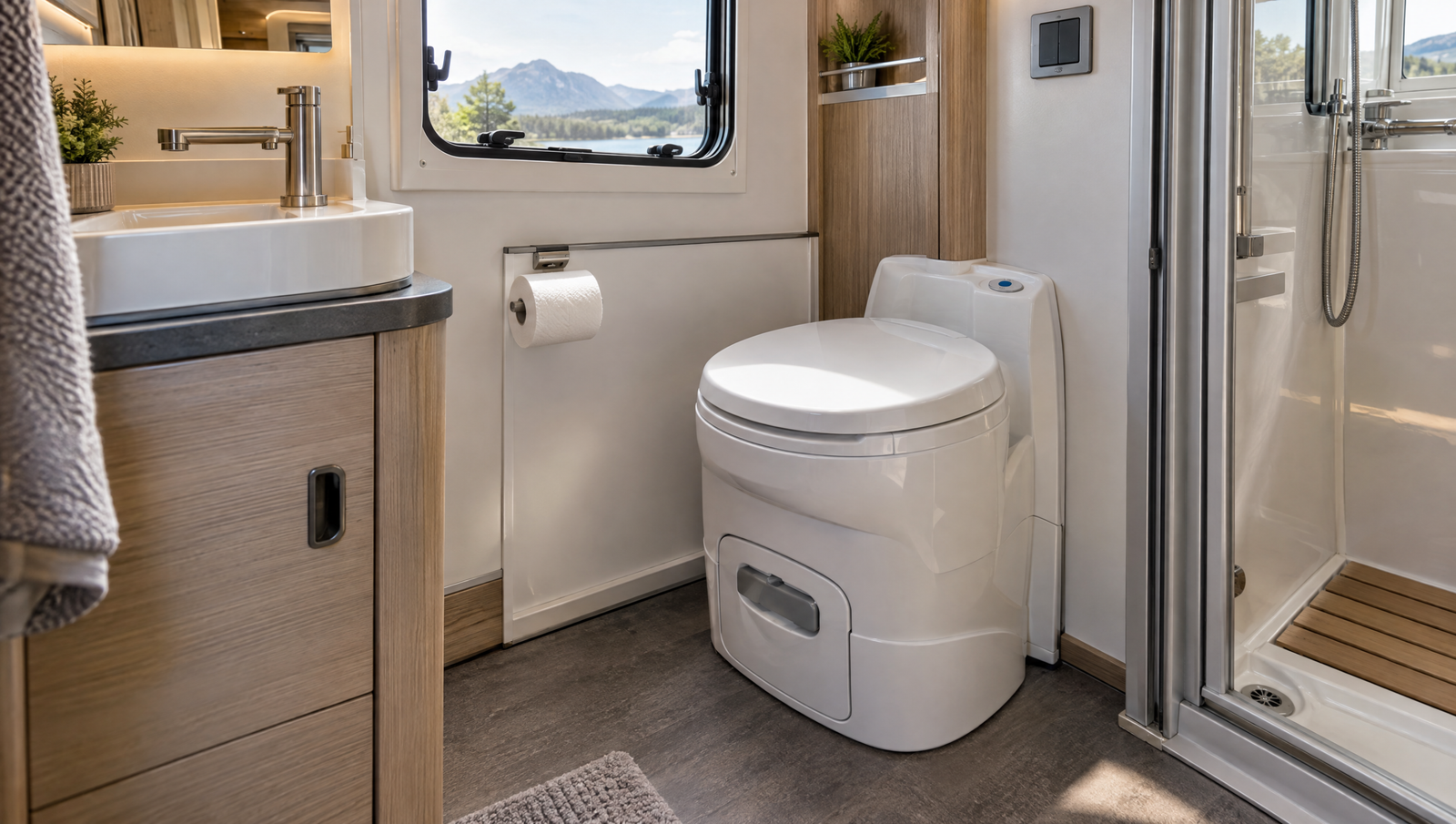
Short answer: A cassette toilet is a permanently installed RV toilet with a small removable waste tank underneath it. The tank — the cassette — slides out through a locked hatch on the outside of the vehicle and can be emptied into any standard toilet. Most hold 4–5 gallons, about 20–30 uses for two people.
If you have been reading van listings and keep hitting the term, this is the one-page explanation. For emptying steps, model comparisons, maintenance and costs, see the full cassette toilet guide.
What is a cassette toilet in an RV?
In an RV or camper van, a cassette toilet replaces the traditional black tank. Instead of waste draining into a large fixed tank that must be emptied at a dump station through a sewer hose, it collects in a small portable tank you can lift out and carry.
The name comes from the tank itself, which slots in and out like a cassette — hence the term, which arrived in the US from European motorhome design where compact bathrooms are the norm.
The three parts that make it work
- The bowl — fixed inside the bathroom, looks and works like a normal RV toilet. Many models have a bowl that swivels to fit tight spaces.
- The blade valve — a sliding seal between the bowl and the tank, so nothing is exposed between flushes. This part is why a well-maintained cassette toilet does not smell.
- The cassette — a 4–5 gallon sealed tank with a pour spout, a vent button, a level indicator and, on better models, wheels and a pull handle.
How a flush works
You open the blade valve with a lever, press the flush button, and water from a small dedicated reservoir rinses the bowl into the cassette below. Closing the valve reseals the tank. The flush water comes from its own tank on most models, so using the toilet does not drain your drinking water supply.
How it differs from a black tank
| Cassette toilet | Black tank | |
|---|---|---|
| Tank | Removable, 4–5 gal | Fixed, 15–40 gal |
| Emptying | Carry to any toilet | Sewer hose at a dump station |
| Frequency | Every 2–4 days | Every 7–14 days |
| Space used | Minimal | Significant |
| Installed cost | $400–$1,200 | $1,500–$3,500 |
The trade is simple: a cassette toilet gives you freedom over where to empty, and a black tank gives you freedom over how often.
Who a cassette toilet suits
- Good fit: camper vans under 22 ft, travellers who move every few days, couples, anyone who wants an indoor toilet without losing floor space, and people who travel where dump stations are scarce.
- Poor fit: families of four staying parked for a week, anyone who wants a separate dry bathroom, or anyone unwilling to handle the cassette themselves.
Most compact Class B RVs and many camper vans for sale use this setup. If you want a full wet bath instead, browse vans with interior shower, and couples can compare compact options in camper vans for 2 people.
Thetford is the most common manufacturer in this category; their model specifications and service parts are published at thetford.com.
The three things new owners get wrong
- Forgetting the vent button while pouring. It prevents the air-lock glugging that causes splashback — and it is the source of most bad first experiences.
- Letting the seal dry out. Lubricating the blade seal every few months prevents nearly every odour and leak complaint.
- Using household toilet paper. It does not dissolve fast enough in a small tank and clogs the pour spout.
Frequently asked questions
What is a cassette toilet in an RV?
It is a fixed RV toilet with a removable 4–5 gallon waste tank accessed through an exterior hatch. You slide the cassette out, carry it to any toilet or dump point, empty it, rinse it and slide it back — no sewer hose required.
Is a cassette toilet a real flushing toilet?
Yes. It has a water reservoir and a flush mechanism, either manual or electric, and a blade valve that seals the bowl from the tank between uses.
Where do you empty a cassette toilet?
Any standard toilet, RV dump station, campground restroom, marine pump-out or your own home toilet. Never into storm drains, vault toilets or onto the ground.
How long does a cassette toilet last before emptying?
About 20–30 uses, or roughly 2–4 days for two people using it full time. Using campground facilities during the day easily doubles that interval.
Do cassette toilets smell bad?
Not when maintained. Odour comes from a dry blade seal, skipped tank treatment, or leaving the cassette full for days. Treat it every dump and empty at three-quarters full.
How heavy is a full cassette?
Around 40–45 lb when full. Wheeled models with an extending handle make this a non-issue; carrying a non-wheeled cassette any real distance is genuinely awkward.
Can you add a cassette toilet to an existing van?
Yes, provided there is a wall position where an exterior service hatch can be cut without hitting a structural rib. Installed cost is typically $700–$1,200 including the unit and labour.