

 souvik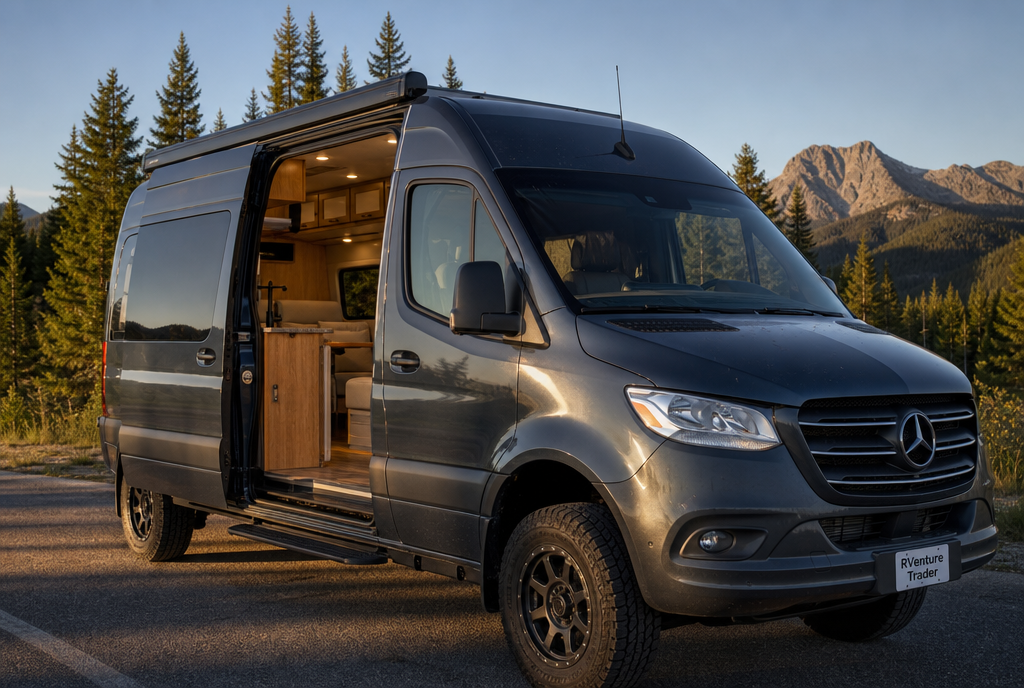
Inside a Mercedes Sprinter Camper Van: Layouts, Sizes and Real Costs
The Mercedes-Benz Sprinter is the default chassis of the premium camper van world. Airstream, Winnebago, Storyteller Overland, Grech, Pleasure-Way and most high-end custom builders all reach for it first — and when buyers picture a Mercedes camper van, they’re almost always picturing a converted Sprinter.
What isn’t obvious from photographs is how much the specification choices underneath change the van you end up living in. A 144-inch standard-roof Sprinter and a 170-inch extended high-roof Sprinter are both “Mercedes camper vans,” and they are completely different vehicles to drive, park, sleep in and heat. This guide covers the decisions in the order they matter.
Short answer: A Mercedes Sprinter camper van is a Sprinter cargo van converted into a self-contained camper. The 2026 Sprinter starts around $50,830 as a bare 144-inch 2500 cargo van and climbs past $62,000 for a 170-inch extended high roof; AWD versions start near $60,500. Finished Sprinter campers typically run $150,000–$300,000 new, or $70,000–$140,000 used.
Why builders choose the Sprinter
Four reasons, in rough order of importance to buyers:
- Diesel range and torque. The 2.0-litre turbodiesel four produces 168–170 hp and 295 lb-ft in standard tune, or 208–211 hp and 332 lb-ft in the high-output version, both paired with a nine-speed automatic. Long legs between fill-ups matters more on a camper than acceleration does.
- Genuine all-wheel drive. AWD is available, though only with the high-output engine. It’s the reason Sprinter-based vans dominate the boondocking and four-season end of the market.
- Standing height without a pop-top. The high-roof body gives most adults full standing room in the living area, which changes how liveable the van feels on a rainy week far more than any gadget.
- Upfitter ecosystem. Mercedes supports third-party conversion extensively, so there’s a mature supply of wall panels, window kits, roof racks, suspension upgrades and electrical harnesses designed specifically for the chassis.
The counterweight is running cost. Diesel servicing at a Mercedes commercial dealer is not cheap, DEF and diesel particulate systems add complexity, and the specialist repair network is thinner than Ford’s. That’s the trade you’re making for the capability.
Choosing the chassis: wheelbase, roof and drivetrain
Every finished Sprinter camper began as one of a handful of configurations. Knowing which one you’re looking at tells you most of what you need to know about the van.
| Configuration | Overall length | 2026 starting MSRP (bare van) | Best suited to |
|---|---|---|---|
| 2500 144″ WB, standard roof | ~234 in | ~$50,830 | Garage-fit builds, stealth use, pop-top conversions |
| 2500 144″ WB, high roof | ~234 in | ~$53,125 | The most popular camper base — couples, standing room, easy parking |
| 2500 170″ WB, high roof | ~274 in | ~$57,540 | Fixed rear bed plus full bathroom and garage |
| 2500 170″ WB extended, high roof | ~290 in | ~$59,980–$62,275 | Families, full-time living, maximum storage |
| 2500 144″ WB, AWD | ~234 in | ~$60,500 | Snow, forest roads, four-season adventure builds |
| 3500 / 3500XD (dual rear wheel) | 144″ or 170″ | ~$56,950–$59,860 | Heavy builds — big water tanks, large lithium banks, full bath |
Two practical notes buyers often miss. The 2500 versus 3500 decision is about payload, not size — a heavily built 144 can run out of payload before it runs out of space, and an overloaded van handles badly and wears through brakes and tyres. And the 170 extended is a genuinely large vehicle at over 24 feet; it will not fit many city parking spaces, some drive-throughs, or a lot of national park campsite pads.
If you already know the size class you want, filter directly by short wheelbase Sprinter and Transit vans or long wheelbase vans.
Inside a Sprinter: the four interior layouts you’ll actually see
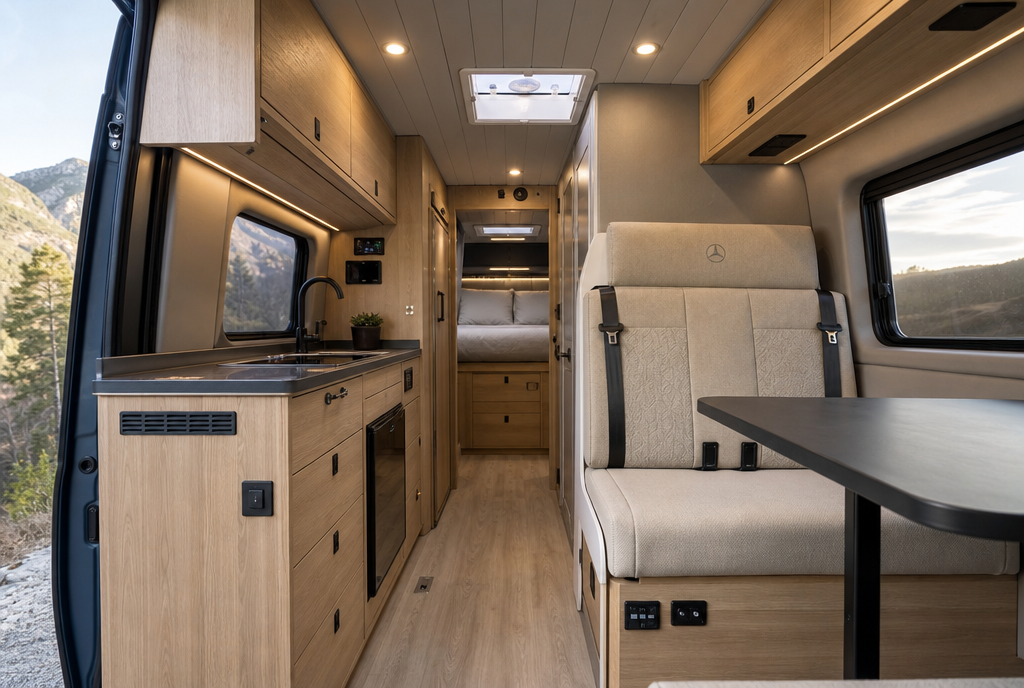
Nearly every Sprinter camper interior is a variation on one of four floorplans. The layout dictates your daily life far more than the cabinetry finish does, so this is the section worth slowing down on.
1. Rear fixed bed (crosswise)
A permanent bed across the back of the van, with storage — the “garage” — underneath for bikes, boards or gear. Kitchen along one wall, bathroom opposite or forward. You never make the bed. The catch: a crosswise bed needs interior width, so tall people either need flares in the walls or a 170 to lie fully stretched.
2. Rear fixed bed (lengthwise) plus full bathroom
Common in 170 builds. The bed runs front-to-back on one side, leaving room for a separate shower cubicle rather than a wet bath. This is the layout most full-timers converge on, because a dry bathroom transforms a winter trip. Requires the long chassis.
3. Convertible dinette or lounge bed
Bench seating that converts to a bed each night. It buys back a lot of daytime living space and works well in a 144, but nightly conversion gets tiresome on trips longer than a week or two.
4. Elevator or pop-top bed over a lounge
A powered bed that lifts to the ceiling during the day, or a roof pop-top that adds a second sleeping level. This is how a 144 sleeps four people. See our guide to pop top camper vans and whether they’re worth it for the trade-offs on insulation, weather sealing and height.
| Layout | Sleeps | Needs | Main trade-off |
|---|---|---|---|
| Rear crosswise fixed bed | 2 | 144 or 170 | Limited length for people over ~6 ft |
| Rear lengthwise bed + dry bath | 2 | 170 or 170 ext | Big vehicle to park and manoeuvre |
| Convertible lounge bed | 2 | 144 | Nightly setup and teardown |
| Elevator bed or pop-top | 3–4 | 144 or 170 | Mechanical complexity; cold upstairs in winter |
Fittings to check regardless of layout: standing height at the point where you’ll actually stand (usually in front of the sink, not the middle of the aisle), whether the fridge door opens without blocking the aisle, insulation type behind the wall panels, and heater type — a diesel air heater draws from the main fuel tank and is far more practical off-grid than a propane furnace. Vans with a proper enclosed shower are listed separately under vans with an interior shower, and our wet bath versus dry bath guide covers how each behaves day to day.
What a Mercedes camper van costs in 2026
| Route | Total cost | Timeline | Notes |
|---|---|---|---|
| New factory Class B (Airstream, Winnebago, Grech, Pleasure-Way) | $150,000–$300,000+ | In stock to 6 months | RV-titled, warrantied, dealer serviced |
| Custom professional conversion | $130,000–$250,000 all-in | 6–18 months | Your layout; verify title classification early |
| Used converted Sprinter (2–5 years old) | $70,000–$140,000 | Immediate | Best value; first-year depreciation already absorbed |
| DIY on a used cargo Sprinter | $45,000–$90,000 | 6 months–2 years of your time | Cheapest per feature; hardest to finance and insure |
Running costs to plan for: insurance at roughly $800–$2,000 a year once converted (higher on a high-value professional build, and 20–40% more again if you live in it full-time), plus diesel servicing. Owners commonly report Mercedes commercial dealer maintenance in the region of $2,000 a year on a working Sprinter. For the full ownership arithmetic, see how much a camper van really costs.
Sprinter vs Transit vs ProMaster, briefly
| Sprinter | Ford Transit | Ram ProMaster | |
|---|---|---|---|
| Engine | 2.0L turbodiesel | Gas V6 / EcoBoost / electric | Gas V6 |
| AWD / 4WD | Yes (high-output engine) | Yes (Intelligent AWD) | No — front-wheel drive |
| Interior width | Narrower | Middle | Widest — crosswise bed fits |
| Servicing cost | Highest | Lowest, widest network | Low |
| Resale | Strongest | Good | Weakest of the three |
Short version: the Sprinter wins on capability and resale, the Transit wins on running cost, and the ProMaster wins on interior width per dollar.
Buying a used Sprinter camper: what to check
- Service history from a Mercedes commercial dealer or diesel specialist. Gaps in DEF and emissions-system maintenance get expensive fast.
- Rust at the rear wheel arches, sill seams and around roof penetrations. Older Sprinters have form here, and every roof fan, solar mount and vent is a potential leak path.
- Water intrusion evidence. Moisture-meter the floor edges, window surrounds and the ceiling around the fan.
- Electrical documentation. Battery chemistry, age, cycle count, inverter and charger models, fuse layout, and whether the solar is actually producing.
- Payload plate versus actual weight. Ask for a weighbridge ticket with tanks full. Overweight vans are common and there’s no cheap fix.
Work through the full used camper van inspection checklist before you commit, and browse current Sprinter camper vans for sale or the wider Mercedes-Benz van inventory to see how spec maps to asking price in your budget band.
Frequently asked questions
How much does a Mercedes Sprinter camper van cost?
A new factory-built Sprinter Class B typically runs $150,000 to $300,000. A used converted Sprinter two to five years old sits around $70,000 to $140,000. The bare 2026 cargo van itself starts near $50,830 for a 144-inch 2500 and reaches roughly $62,275 for a 170-inch extended high roof.
Is the 144 or the 170 wheelbase better for a camper?
The 144 if you want one vehicle that also functions as a daily driver and parks normally; the 170 if you need a fixed lengthwise bed plus a separate dry bathroom, or you’re travelling as a family. The 170 extended is over 24 feet long and starts to limit where you can go.
Do you need the AWD Sprinter?
Only if you regularly drive unpaved forest service roads, snow or sand. For paved-road travel with occasional gravel, a rear-wheel-drive Sprinter with quality all-terrain tyres and some added weight over the axle covers most situations for thousands less.
What’s the interior height of a high-roof Sprinter camper?
High-roof Sprinters give most adults full standing room in the living area, though finished conversions lose a couple of inches to floor build-up and ceiling insulation. If you’re over about 6’2″, measure the specific van rather than trusting the brochure — the usable figure varies by builder.
How reliable is a Sprinter camper van?
The drivetrain is durable and high-mileage Sprinters are common in commercial fleets. The failure points are emissions-system components, and cost of repair rather than frequency of repair. A documented service history matters more on a Sprinter than on almost any other camper chassis.
Can a Sprinter camper van sleep four?
Yes, with an elevator bed or a pop-top over a convertible lounge, or a 170 with a rear fixed bed plus a front dinette conversion. Four people in a Sprinter is workable for holidays; for extended trips with children, read our guide to choosing a camper van for a family of four first.
Where to go from here
Pick the chassis size before the cabinetry, verify payload before you fall in love with a build, and always confirm how the van is titled if you plan to use RV financing. When you’re ready to compare real vans, start with Sprinter camper vans for sale and narrow by layout, or look at luxury camper vans if fit and finish is your priority.