

 souvik
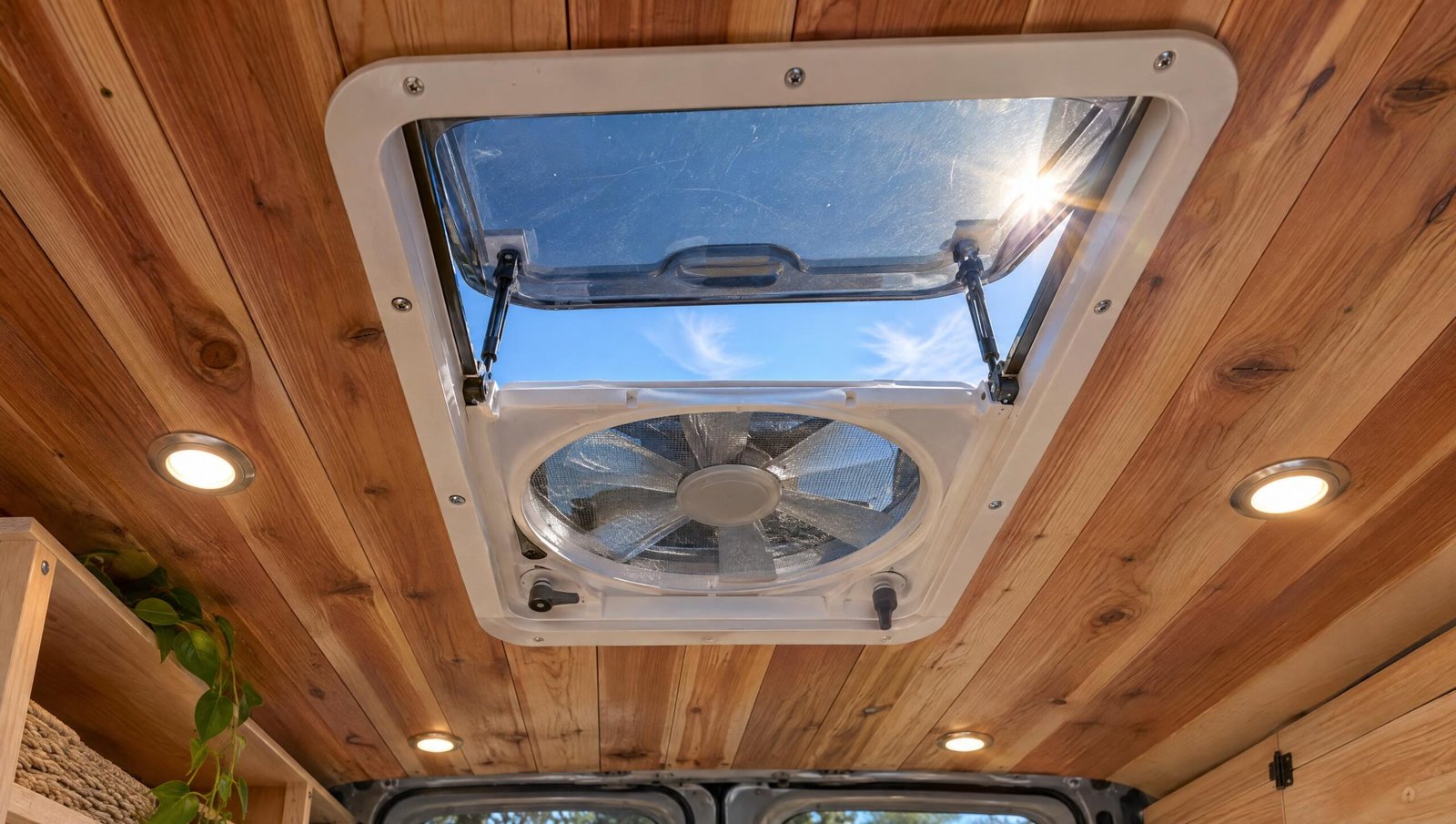
Camper Van Roof Vent Fan: Which Type to Buy, Where to Put It and What It Costs (2026)
By the RVenture Trader team
Short answer: A camper van roof vent fan is the most useful $200 to $400 you can spend on a build. One 14 by 14 inch fan with a low intake opening handles most vans. It draws well under 1 amp on low speed and about 3 to 5 amps on high. A second fan helps in long-wheelbase vans and hot climates.
Before the bed, the fridge or the batteries, a van needs a way to move air. Without one, two people breathing overnight fog the windows by morning, cooking smells settle into the upholstery, and summer afternoons are miserable.
The fan is also the first hole most people cut in a roof worth tens of thousands of dollars. It is worth understanding before the jigsaw comes out.
What a Roof Fan Does
- Removes moisture. Breathing, cooking and wet gear put a surprising amount of water into the air. It condenses on cold metal and, in time, feeds mold and rust.
- Dumps heat. Hot air collects at the ceiling. A fan pulling it out and drawing cooler air in low is far more effective than an open window alone.
- Clears cooking fumes and odors.
- Supports safety. Ventilation is one layer of protection alongside detectors when you use combustion appliances. The CPSC carbon monoxide guidance explains the risks clearly.
A fan does not cool air below the outside temperature. That takes air conditioning, which we cover in can you run AC in a camper van.
Fan Types Compared
Almost every van fan fits the same 14 by 14 inch roof opening, which makes later replacement easy.
| Type | Price | Runs in rain | Power on high | Best for |
|---|---|---|---|---|
| Basic manual vent, no fan | $30–$80 | With a cover | None | Secondary vent |
| Single-speed powered fan | $80–$150 | With an add-on cover | 2–3 A | Tight budgets |
| Multi-speed fan with thermostat | $200–$300 | Depends on model | 3–5 A | Most builds |
| Multi-speed with built-in rain shield and remote | $280–$400 | Yes | 3–5 A | Full-time use |
| Low-profile fan | $250–$450 | Yes | 3–5 A | Roofs crowded with solar |
For full-time travel, a fan with a built-in rain shield is worth the extra money. A storm at 3 a.m. is exactly when you want the fan to keep running without getting out of bed to close a lid.
Power use
On its lowest setting a good fan draws a fraction of an amp, so running it all night uses only a few amp-hours. That is nothing for a lithium bank and manageable even for a modest setup. Our camper van electrical system guide shows how to add up loads like this.
Where to Put the Fan
There are two schools of thought.
Over the bed, at the rear. It pulls air across you while you sleep, which feels great on warm nights. It is the most common choice.
Over the galley, forward. It takes cooking steam and smells straight out. This is a good location when the bed sits under solar panels.
Either way, a fan needs somewhere for replacement air to enter. Crack a window or a floor vent at the opposite end of the van, low down if you can. Air then travels the whole length of the cabin. A fan with every window shut does very little.
In a 170-inch or extended van, two fans are common: one set to exhaust and one to intake. It creates a steady breeze with the doors closed. Pop-top vans work differently, since the canvas vents itself. See vans with pop tops for examples.
Installation: What It Involves and Costs
| Route | Typical cost |
|---|---|
| DIY: fan, sealant, butyl tape, trim, wiring | $250–$450 |
| Shop install, fan supplied | $200–$500 labor |
| Shop install with fan | $500–$900 |
The basic sequence:
- Mark the opening between roof ribs and check for wiring above the headliner
- Cut the hole, file the edges and prime the bare metal
- Add an interior wood or metal frame so the flange clamps on something solid
- Bed the flange in butyl tape and screw it down evenly
- Cover every screw head and the flange edge with self-leveling lap sealant
- Run fused 12V wiring and fit the interior trim ring
Roofs are curved and often ribbed, so many builders use a contoured adapter to give the fan a flat seat. If you are planning the whole build, our cargo van conversion guide puts the fan near the start, before insulation.
What Goes Wrong
The stories we hear from owners and see in inspection photos are consistent.
Leaks nearly always trace back to sealant, not the fan. Lap sealant dries and cracks after a few years in the sun. It needs a look twice a year and a fresh bead now and then. Plain silicone from a hardware store tends to peel on a van roof and makes later repairs harder.
Rust starts at the cut edge when bare metal was not primed. It hides under the flange for years.
Noise complaints usually mean a cheaper fan running on high. Quieter fans run slow most of the time, so buy for airflow at low speed.
And the classic: driving off with the lid open. Models with a rain shield tolerate it. Flip-up lids do not last long at 70 miles an hour.
Beating Condensation
A fan is half of the answer. The rest is insulation, covered in which insulation keeps a camper van comfortable, and habits.
- Run the fan on low all night with a window cracked
- Use lids when you cook and run the fan on high
- Dry wet clothes outside when you can
- Favor dry heat. A vented diesel or gasoline air heater dries the cabin, while unvented propane heaters add moisture. See how to heat a camper van
- Wipe windows in the morning before the water runs into the door panels
Frequently Asked Questions
Do I need a roof vent fan in a camper van?
Yes for almost every build. It is the main way to control moisture, heat and cooking fumes, and it uses very little power.
How many roof fans does a camper van need?
One is enough for most vans up to a standard long wheelbase, paired with a low intake opening. Two fans suit extended vans, hot climates and people traveling with pets.
How much power does a van roof fan use?
Well under 1 amp on low and roughly 3 to 5 amps on high at 12 volts. Overnight use on a low setting typically consumes only a few amp-hours.
Can I run a roof fan while it rains?
Yes, if the fan has a built-in rain shield or you add a vent cover. Standard flip-up lids must be closed in heavy rain.
How much does it cost to install a van roof fan?
About $250 to $450 as a DIY project including the fan, or $500 to $900 installed by a shop.
Prefer a Van That Is Already Built?
Every professionally built van in our listings has ventilation sorted. Browse camper vans for sale and check the roof photos for fan count and placement.