
 souvik
Camper Van Weight and Payload: GVWR Limits and How to Stay Under Them (2026)
By the RVenture Trader team
Short answer: A finished full-size camper van weight usually lands between 8,000 and 10,500 pounds, loaded for travel. The limit that matters is GVWR, printed on the driver’s door jamb. Most 2500-class vans are rated near 9,000 pounds, and many heavy builds run within a few hundred pounds of it. Weigh your van at a truck scale to know for sure.
Weight is the least exciting topic in van life and one of the few that affects safety, legality, tire life, braking and insurance all at once. It is also invisible. An overweight van looks exactly like a legal one until something goes wrong.
The Three Numbers That Matter
- GVWR (gross vehicle weight rating): the maximum the van may weigh with everything in it, including people, fuel, water and gear
- Curb weight: the empty van with fluids, before the build
- Payload: GVWR minus curb weight. This is your total budget for the build and everything you carry
There is a fourth worth checking: GAWR, the limit for each axle. A van can be under GVWR and still overload the rear axle if the water, batteries and bikes all sit behind it.
Typical GVWR by Van
Ratings vary by model year, wheelbase, roof and drivetrain. Use this table for orientation and the door sticker for the truth.
| Van | Approximate GVWR | Notes |
|---|---|---|
| Mercedes Sprinter 2500 | about 9,050 lb | Most common camper base |
| Mercedes Sprinter 3500 / 3500XD | about 9,990–11,030 lb | Dual rear wheels on many |
| Mercedes Sprinter 4500 | about 12,125 lb | Heavy builds, larger families |
| Ford Transit 250 | about 9,070 lb | |
| Ford Transit 350 | about 9,500–9,950 lb | |
| Ford Transit 350HD | up to about 11,000 lb | Dual rear wheels |
| Ram ProMaster 2500 | about 8,900 lb | |
| Ram ProMaster 3500 | about 9,350 lb |
An empty high-roof cargo van commonly weighs 5,500 to 6,500 pounds, leaving roughly 2,500 to 4,000 pounds of payload. All-wheel drive and longer bodies eat into that. Manufacturer specifications are published on the Mercedes-Benz Vans and Ford sites.
Where the Weight Goes
People are always surprised by this list. Nothing on it looks heavy alone.
| Item | Typical weight |
|---|---|
| Insulation, walls, ceiling, floor | 300–500 lb |
| Cabinets, bed platform, galley | 400–800 lb |
| Lithium batteries, inverter, wiring | 150–350 lb |
| Solar panels and roof rack | 100–250 lb |
| Fresh water, 30 gallons | 250 lb |
| Fridge, heater, fan, AC | 100–250 lb |
| Windows, swivels, extra seats | 100–300 lb |
| Bumpers, ladder, tire carrier, awning | 150–400 lb |
| Two adults | 300–400 lb |
| Clothes, food, tools, bikes, toys | 300–600 lb |
Add it up and a comfortable build with two people and their gear puts 2,200 to 4,000 pounds on the chassis. On a 2500-class van, that is most or all of the payload.
Layout and length play into this too. Our long vs short wheelbase guide explains how the extended bodies trade payload for space.
What We Notice in Listings
Ask a seller what their van weighs and most do not know. The sellers who do know tend to be the ones with the best-documented builds, and their weigh ticket is often sitting in the same folder as the wiring diagram.
Heavy off-road accessories are the usual tipping point. A steel front bumper with a winch, a rear tire carrier, a roof rack and a lift kit can add 500 pounds before anyone packs a bag. It is a little ironic. The vans built to go furthest off the pavement are often the ones carrying the least margin. If you are weighing up that route, read do you really need a 4×4 camper van first.
Families hit the limit differently. Four people, four sets of gear and extra seats add up quickly, which is why builders often move to a 3500 chassis for a camper van for a family of 4.
How to Weigh Your Camper Van
- Load the van as you travel: full fuel, full water, everyone aboard, all gear
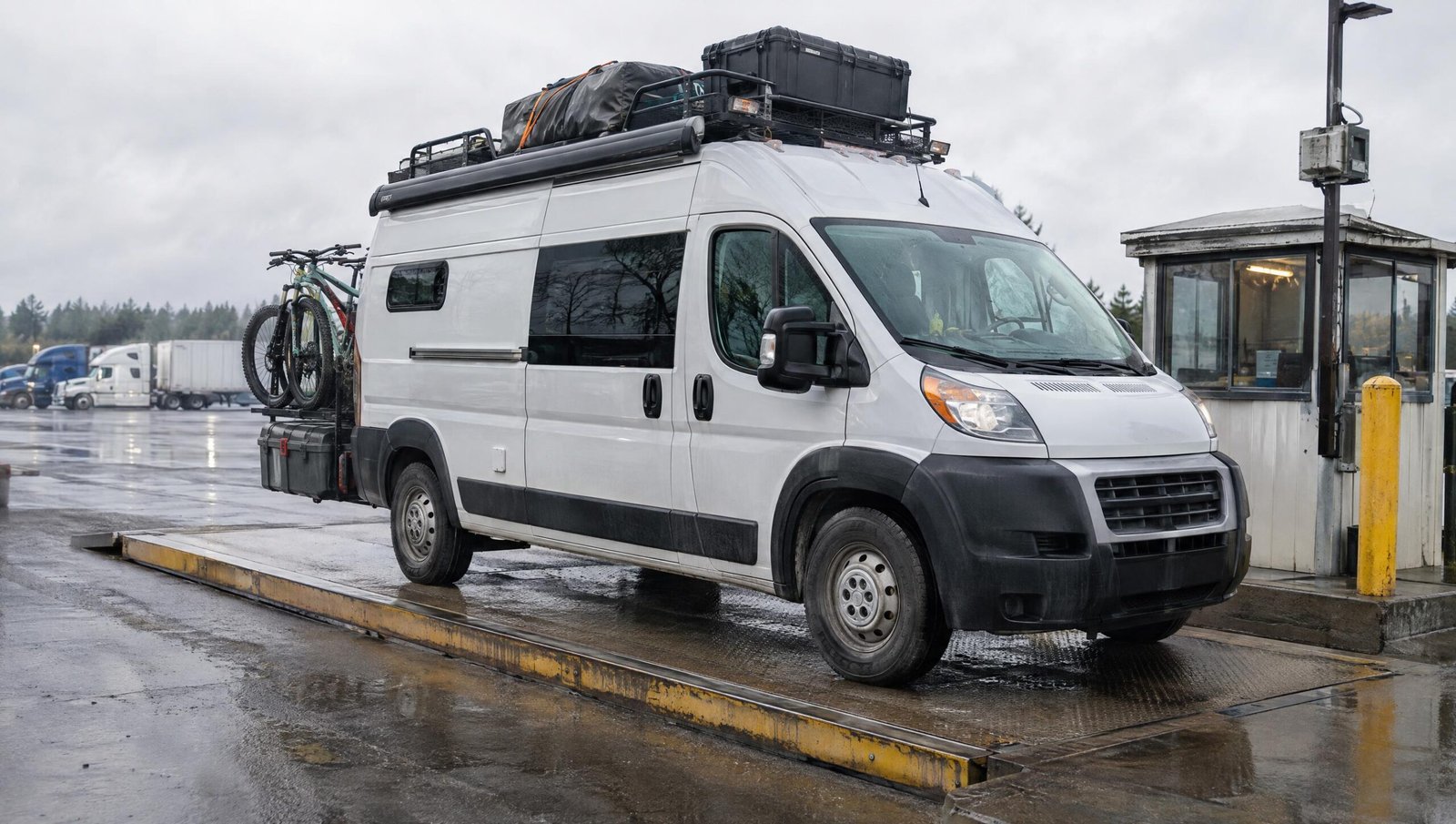
- Find a certified truck scale. CAT Scale locations at truck stops are the easiest, and a weigh usually costs under $20
- Stop with the front axle on the first platform and the rear axle on the second
- Collect the ticket showing each axle and the total
- Compare the total with GVWR and each axle with its GAWR on the door sticker
Do it once after the build and again when anything major changes.
What Happens if You Are Overweight
- Longer stopping distances and faster brake wear
- Tires running beyond their load rating, which raises blowout risk. The NHTSA tire guidance explains load index and inflation
- Sagging rear suspension and vague steering
- Possible trouble with an insurance claim after an accident
- Faster wear on wheel bearings, transmission and shocks
How to lose weight
- Travel with less water when you know you can refill
- Swap heavy plywood for lighter panels where strength is not needed
- Choose aluminum over steel for racks and bumpers
- Move heavy items forward of the rear axle
- Be honest about gear you carried all last season and never touched
Upgraded springs, airbags or shocks improve how a heavy van rides. They do not raise GVWR. Only the manufacturer’s rating counts.
Frequently Asked Questions
How much does a camper van weigh?
A built full-size camper van typically weighs 8,000 to 10,500 pounds loaded. Compact vans weigh far less, and heavy dual-rear-wheel builds can exceed 11,000 pounds.
What is the payload of a Sprinter camper van?
An empty Sprinter 2500 cargo van offers roughly 2,800 to 4,000 pounds of payload depending on configuration. After the conversion, what remains for people and gear is often only a few hundred pounds.
Is it illegal to drive an overweight camper van?
Exceeding the manufacturer’s GVWR can result in a citation in some jurisdictions and may complicate insurance claims. More importantly, it reduces braking and tire safety.
Does adding airbags increase payload capacity?
No. Suspension upgrades improve ride height and handling, but the legal weight rating stays the same as the door sticker.
Where can I weigh my camper van?
Certified truck scales at truck stops are the simplest option. Some landfills, moving companies and gravel yards also have public scales.
Shop Builds With Room to Spare
If you carry a lot, start with a chassis that can take it. Browse Sprinter and Transit long wheelbase vans and ask sellers for the GVWR and a recent weigh ticket.