
 souvik
Van Life With a Dog: Layout, Heat Safety and What It Really Costs (2026)
By the RVenture Trader team
Short answer: Van life with a dog works well if you plan for three things: temperature control, floor space and where dogs are allowed. A powered roof fan, good insulation and a remote temperature monitor are the minimum for warm weather. National forests and BLM land are far more dog friendly than most national parks.
Dogs are good at this life. They do not care about the size of the galley. They get a new smell every morning and their people nearby all day.
The hard part falls on you. A van is a metal box, and the things that make it comfortable for a human in mild weather can make it dangerous for a dog in a parking lot in July.
Heat: The Part You Cannot Get Wrong
The American Veterinary Medical Association reports that the temperature inside a parked vehicle can rise by about 20°F in ten minutes, and cracking a window does very little. A camper van with insulation and a fan is better than a car. It is still a vehicle in the sun.
What actually helps:
- Insulation and window covers. Reflective covers on the windshield and cab windows make the biggest single difference. See which insulation keeps a van comfortable.
- A powered roof fan pulling air through, with a second opening low down for intake.
- Air conditioning with enough battery to run it. Our guide on running AC in a camper van has the battery math.
- A remote temperature monitor that sends alerts to your phone over cellular. They cost roughly $100 to $250 plus a small subscription.
- Shade and timing. Park nose-away from the sun, run errands early, and when it is truly hot, the dog comes with you or you do not go.
No gadget makes a parked van safe in real heat. Monitors fail, batteries run down and compressors trip. Treat the equipment as a backup. Your own judgment has to come first.
A Layout That Works With a Dog
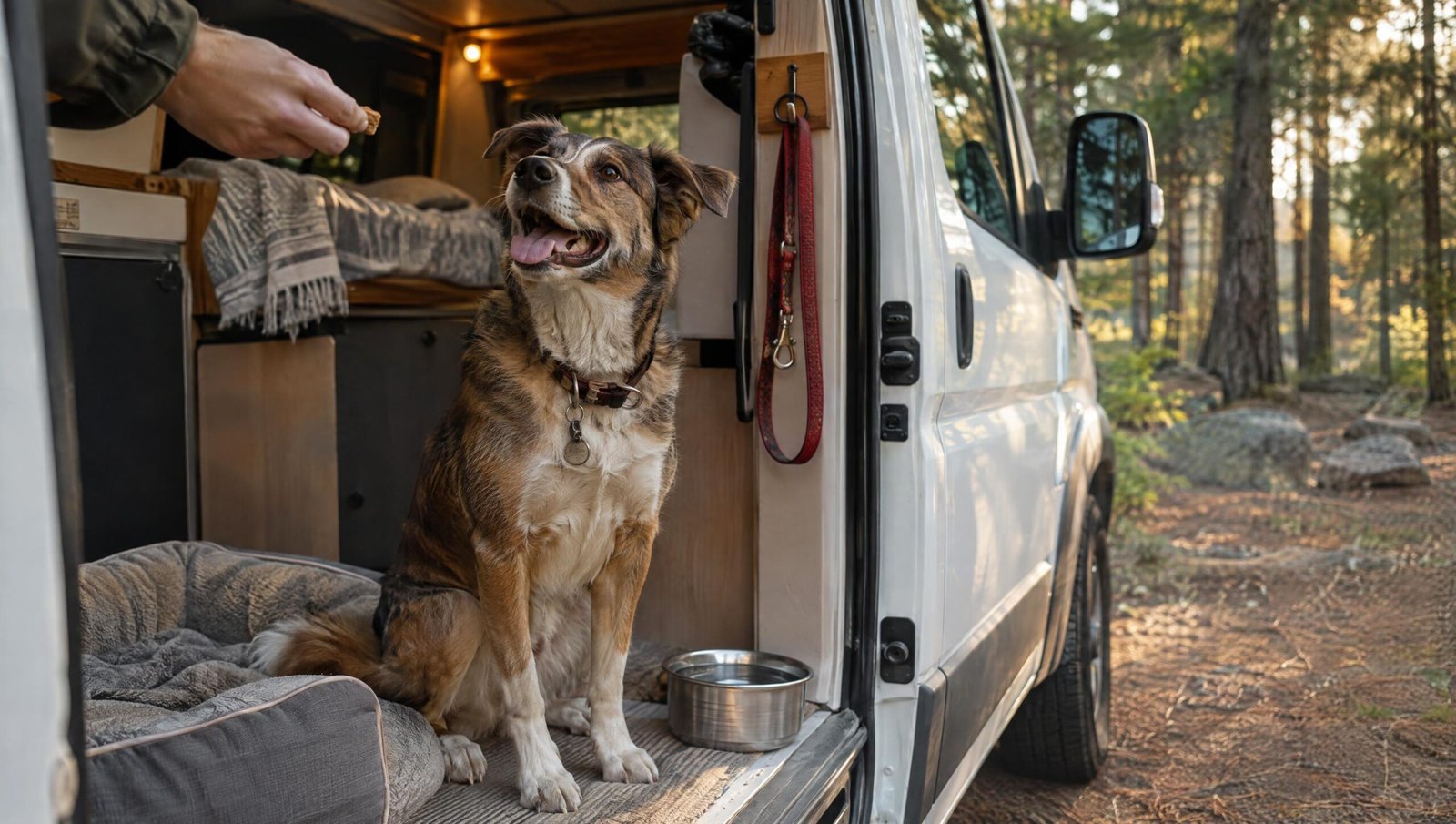
Most van layouts are designed around two adults. Add a 60-pound dog and the aisle disappears.
| Feature | Why it matters with a dog |
|---|---|
| Open floor between galley and bed | A place to lie down that is not in the walkway |
| Lower bed height or a step | Older dogs and big jumps do not mix |
| Vinyl or sealed flooring | Mud, sand and water bowls |
| Garage under the bed | Wet gear, food bins and a crate stay out of the cabin |
| Sliding door screen | Airflow without an escape route |
| Outdoor shower or rinse port | Wash paws before they reach the bed |
| Fixed water bowl spot | Fewer spills while driving |
Short-haired dogs in a small van do fine. Two large dogs want a longer body. Many couples traveling with a dog end up in a 170-inch wheelbase or similar. You can compare sizes in the camper vans for couples collection.
Travel safety
A loose dog becomes a projectile in a hard stop. A crash-tested harness clipped to a seat belt, or a secured crate, protects the dog and the people in front. The American Kennel Club has sound advice on car travel and restraint.
Where Dogs Are and Are Not Welcome
This catches new van owners more than anything else.
- National parks: dogs are usually limited to roads, campgrounds, parking areas and a few paved paths. Most trails are off limits. Check the National Park Service pet rules for the park you plan to visit.
- National forests: generally welcoming, with leash rules in developed areas
- BLM land: broadly dog friendly, which is one reason dispersed camping suits dog owners
- State parks: it varies widely. Most allow leashed dogs in campgrounds
- Cities: fine for walking, harder for leaving a dog while you eat or shop
The practical result is that many dog owners plan routes around public land. Our boondocking 101 guide and the Colorado dispersed camping guide are good starting points.
What Dog Owners Tell Us
A few things come up in nearly every conversation with people who travel with dogs.
Hair gets everywhere, including inside the roof fan and the fridge vents. A small 12V or cordless vacuum earns its space within a week.
The dog decides the daily schedule. Mornings start with a walk whether or not you slept well. People say this is the best part and mean it.
Water use rises. A large dog drinks a gallon or more on a hot, active day, and rinsing paws uses more. Size your tank with that in mind.
And the long national park day you imagined often turns into one of you hiking while the other waits. Couples take turns. Solo travelers build their trips around places where the dog can come along.
Monthly Cost of Van Life With a Dog
| Expense | Typical monthly cost |
|---|---|
| Food | $40–$120 |
| Preventatives: flea, tick, heartworm | $25–$60 |
| Routine vet care, averaged | $30–$70 |
| Temperature monitor subscription | $5–$15 |
| Occasional daycare or boarding | $0–$150 |
| Gear replacement | $10–$30 |
| Total | $110–$445 |
Keep vaccination records as photos on your phone. Campgrounds, boarding kennels and border crossings ask for them. An emergency vet fund is worth having too, because the nearest clinic may be two hours away.
Frequently Asked Questions
Can you leave a dog alone in a camper van?
Only in mild weather, for short periods, with ventilation running and a temperature monitor active. In hot or very cold conditions, do not leave a dog in the van.
What is the best camper van for dogs?
One with open floor space, hard flooring, strong ventilation and enough battery to run a fan or AC. A long wheelbase helps with large or multiple dogs.
Are dogs allowed in national parks?
Mostly in developed areas only, such as campgrounds, roads and parking lots. Trails are generally closed to pets, so check each park’s rules before you go.
How do you keep a dog cool in a van?
Use reflective window covers, park in shade, run a roof fan with a low intake vent, and use air conditioning when you have the power. Avoid leaving the dog during the hottest hours.
How much does it cost to travel with a dog in a van?
Most owners spend $110 to $450 a month on food, preventatives, vet care and occasional boarding, on top of normal van life costs.
Find a Van With Room for Everyone
Look for open floor plans and real climate control. Browse camper vans for sale and ask sellers about fan placement, AC and battery capacity before you fall for the paint color.